
Indulge in the irresistible charm of thin, crispy Jalebi – a beloved Indian sweet. Master the art of making them at home with our easy, step-by-step instructions, guaranteeing perfect homemade Jalebis every single time.

The Sweet Allure of Homemade Jalebi: Your Go-To Recipe for Perfection
There are few desserts that evoke as much nostalgia and pure delight as Jalebi. This iconic Indian sweet, with its distinctive spiral shape, vibrant golden hue, and irresistibly crisp, syrup-soaked texture, holds a special place in the hearts of many. For me, it’s a profound weakness – but only for homemade Jalebi. While countless sweet shops offer this delicacy, nothing compares to the fresh, authentic taste of Jalebi prepared in a home kitchen, especially my mother’s rendition. Her Jalebis are simply legendary, and it’s an honor to share her perfected recipe with you today. Forget everything you thought about making Jalebi; this guide will transform you into a Jalebi maestro!
Like the intricate process of creating a flavorful chicken biryani, the thought of making Jalebi from scratch often intimidates aspiring home cooks. The seemingly complex steps and the desire for that perfect crispness can seem daunting. However, I promise you, this recipe demystifies the entire process. Once you dive into the instructions, you’ll realize just how achievable and rewarding it is to make these golden spirals of joy in your own kitchen.
Table of Contents: Homemade Jalebi Perfection
- Reasons Why You’ll Adore This Jalebi Recipe
- Five Easy Steps to Making Flawless Homemade Jalebi
- Watch How to Make Jalebi: Recipe Video
- Homemade Jalebi Recipe Card
- More Festive Desserts to Explore
Reasons Why You’ll Adore This Jalebi Recipe
Contrary to popular belief, preparing Jalebi at home doesn’t require a culinary degree or hours of strenuous effort. With our meticulous step-by-step instructions, you’ll find the process surprisingly straightforward and enjoyable. Here’s a breakdown of why this recipe stands out and why you’ll love making Jalebi with us:
- Minimal Ingredients: This delightful dessert requires just six primary ingredients, with water being the seventh (and hardly counting as an “actual” ingredient!). Chances are, most of these staples – flour, yogurt, sugar, milk, lime, and perhaps even saffron – are already comfortably nestled in your pantry. No special trips to exotic stores needed!
- Leveraging Resting Time: The secret to truly flavorful and textured Jalebi lies in its ‘resting time.’ The initial batter, a simple mixture of flour and yogurt, needs a period to ferment. This natural fermentation is what develops those nuanced flavors and creates the perfect airy texture once fried. The active cooking steps are remarkably quick, making the waiting period the longest part of the process.
- Embrace Imperfection: Don’t obsess over perfectly symmetrical spirals! While beautiful to look at, an imperfectly shaped Jalebi tastes just as magnificent. The true joy of homemade cooking is in the flavor and the experience, not just visual perfection. Feel free to get creative with your swirls – they’re all equally delicious!
- Mastering Thickness for Crispness: The ideal Jalebi should be thin and delightfully crisp, not thick and chewy. Traditionally, cooks used a cloth with a small hole to pipe the batter. For modern convenience and consistent results, we recommend using a squeezy bottle. Its narrow nozzle creates the perfect thin stream of batter, ensuring your Jalebis achieve that sought-after delicate crunch. Hold the bottle 2-3 inches above the hot oil for optimal batter flow.
- Precision in Temperature Control: For beginners, closely monitoring the temperatures of both the oil and the sugar syrup is a game-changer. This crucial step directly impacts the crispness and syrup absorption of your Jalebis.
- Oil Temperature: Aim for a consistent 176°C (350°F). This ensures the batter immediately puffs up and cooks evenly upon contact, resulting in a light and crispy texture. If the oil is too cool, Jalebis will absorb too much oil and become greasy; if too hot, they’ll burn quickly without cooking through.
- Sugar Syrup Temperature: The syrup should reach 100°C (212°F). Crucially, it should NOT reach the “one-thread consistency.” If the syrup is too thick, it will form a hard, sugary crust on the outside of the Jalebi, making it overly sweet and less enjoyable. A thinner, warm syrup allows for proper absorption and a balanced sweetness.
Five Easy Steps to Making Flawless Homemade Jalebi
Creating these golden spirals of joy is a delightful culinary journey. Follow these five simple steps to achieve perfect homemade Jalebis:
1. The Levain (Fermented Batter Base)
The foundation of exceptional Jalebi is the levain – a fermented batter made from all-purpose flour, yogurt (often referred to as curd in India), and water. This mixture is the heart of the Jalebi, developing a subtle tang and the perfect texture through fermentation. The time required for this process varies significantly with ambient temperature. In warmer climates, it might be ready overnight, while in colder regions, it could take up to a full day. To encourage fermentation in cooler settings, place your covered jar of batter in a warm spot, like near a sunny window or in a slightly warm (turned-off) oven. You’ll know your levain is perfectly ready when you observe small, active bubbles forming on its surface, and a slight sour aroma and taste will confirm its readiness.
2. Crafting the Clear Sugar Syrup
Once your levain is fermenting beautifully, it’s time to prepare the sugar syrup. This vibrant, saffron-infused syrup is where the Jalebis get their signature sweetness and color. To ensure a pristine, clear syrup, we employ a clever traditional trick: add a few tablespoons of milk and a squeeze of lime juice to the sugar and water mixture while it boils. As the mixture heats, the milk proteins will coagulate, trapping any impurities present in the sugar. Simply skim off this frothy scum with a slotted spoon, leaving you with a beautifully clear syrup. Finally, infuse it with fragrant saffron strands, simmering gently until it reaches precisely 100°C (212°F). Remember, avoid one-thread consistency – we want a fluid syrup for maximum absorption and a delicate finish.
3. Preparing the Final Jalebi Batter
With your levain fermented and syrup ready, it’s time to finalize the batter for frying. Take a portion of your active levain and whisk in additional all-purpose flour and water until you achieve a smooth, pourable consistency. Think of it as slightly thinner than heavy cream – neither too thick to pipe nor too runny to hold its shape. The consistency is key to achieving thin, crispy Jalebis. For a visual guide, refer to our accompanying video to perfectly gauge the batter’s texture. Transfer this final batter into a squeezy bottle, ensuring an even and controlled stream during frying.
4. The Art of Frying Jalebi
Frying Jalebis might seem tricky at first, but it’s a skill quickly perfected with a little practice. For an authentic and deeply aromatic flavor, we highly recommend using ghee (clarified butter) for frying. While it requires a generous amount, the unparalleled taste it imparts is absolutely worth it. Heat your ghee or oil in a flat-bottomed shallow pan to the precise temperature of 176°C (350°F). If you don’t have a thermometer, a quick test involves dropping a tiny bit of batter into the oil; if it immediately floats to the surface and sizzles, your oil is ready. Hold your squeezy bottle a few inches above the hot ghee and pipe out small, concentric spirals. Don’t worry about achieving perfect shapes initially – embrace the process, experiment with different swirls, and remember that taste trumps aesthetics!
5. Soaking the Golden Spirals in Syrup
The final, exciting step is to immerse your freshly fried, hot Jalebis into the warm sugar syrup. Timing is critical here: they only need a brief soak of approximately 45-60 seconds. Any longer, and they will become excessively sweet and begin to turn soggy, losing their coveted crispness. Use a slotted spoon or tongs to gently press them into the syrup, ensuring they are fully coated, then quickly remove them. Serve these glistening, fragrant Jalebis immediately to enjoy them at their absolute best.
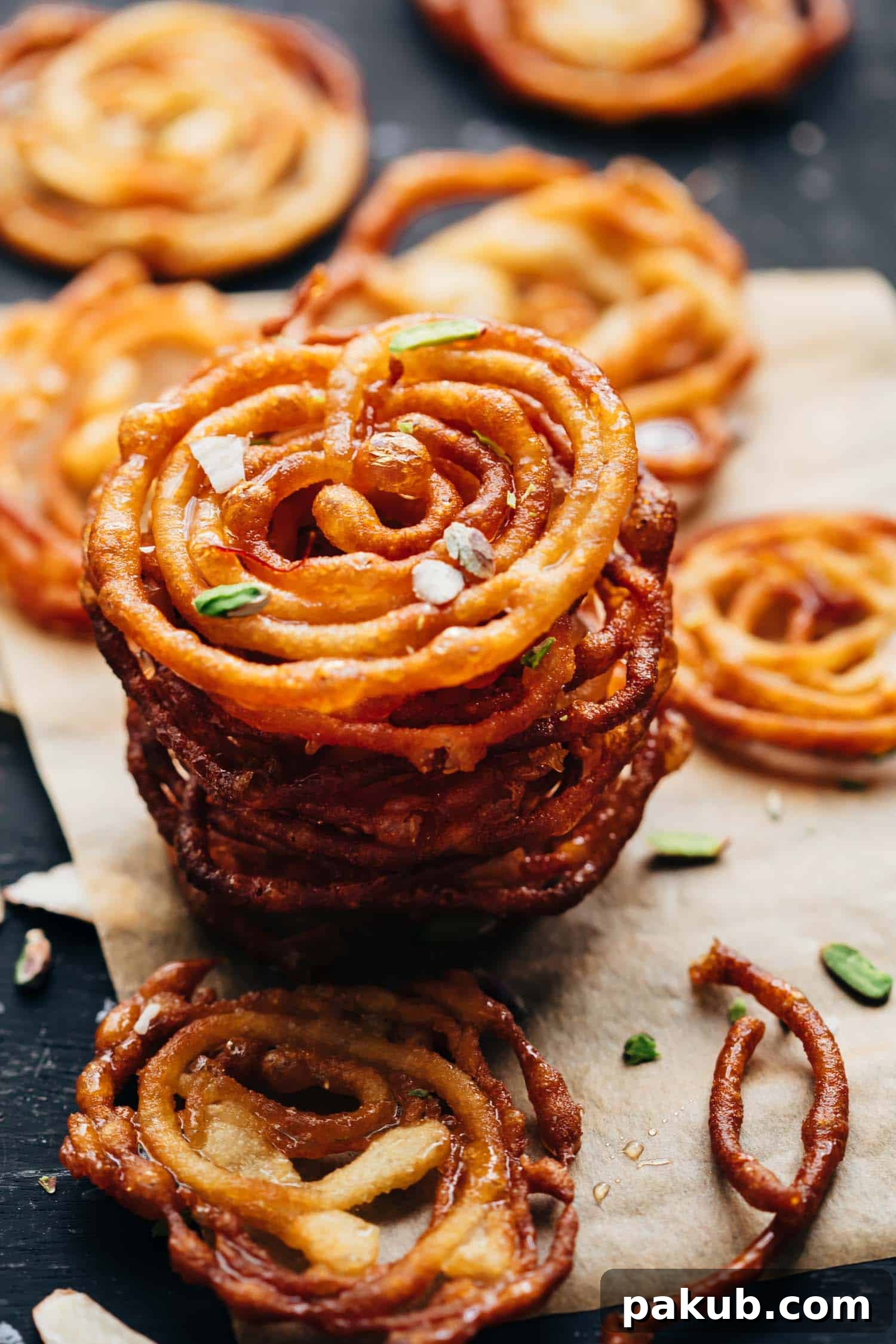
The true magic of Jalebi unfolds when you experience these crispy, thin, and aromatic homemade delights. Each bite is a symphony of textures and flavors, from the delicate crunch to the sweet, saffron-infused syrup. The beautiful golden color is entirely natural, thanks to the saffron, offering a treat for both the eyes and the palate. This is what truly elevates homemade Jalebi to something extraordinary and unforgettable.
Watch How to Make Jalebi: Recipe Video

Homemade Jalebi – Thin and Crispy
Richa
15 minutes
25 minutes
40 minutes
4 Portions
Rate Recipe
Print Recipe
Ingredients
Levain
- 1/4 cup All Purpose Flour, maida
- 2 tablespoons Curd, yogurt
- 2 tablespoons Water
Batter:
- 1/4 cup All Purpose Flour, maida
- 1/4 cup Water
Sugar Syrup & Frying:
- 2 cups Sugar
- 2 cups Water
- 3 tablespoons Milk, to clean the syrup
- 1 teaspoon Lime juice, to clean the syrup
- 12-15 Saffron, strands
- 2 tablespoons Ghee, preferably or Oil to fry
Instructions
-
Whisk together 1/4 cup all-purpose flour with 2 tablespoons each of curd (yogurt) and water. Pour this mixture into an airtight container, ensuring there’s enough space for the batter to rise slightly. Leave it in a warm, dry place overnight or for up to 2 days, depending on your local weather conditions. When the batter is ready, you will observe small bubbles forming on the surface due to fermentation, and it will have a slightly sour taste. This is your levain.
-
In a separate pan, combine sugar and water. Heat the mixture, stirring occasionally, until the sugar fully dissolves. Add 3 tablespoons of milk and the lime juice to the syrup and bring it to a boil for a couple of minutes. You’ll notice the milk curdling and trapping impurities from the sugar; carefully skim this scum off with a slotted spoon and discard it to achieve a clear sugar syrup. Stir in the saffron strands and let the syrup simmer on low heat until it reaches a temperature of 100°C (212°F). It is crucial that the syrup does not reach the one-thread consistency. Keep the syrup warm over very low heat; you can add a few teaspoons of water later if you need to thin it out slightly.
-
When you are ready to fry the Jalebis, take 3 tablespoons of the prepared levain. Whisk it thoroughly with 1/4 cup of fresh all-purpose flour and 1/4 cup of water until the batter is smooth and lump-free. The final batter should have a pouring consistency, akin to heavy cream – it should not be too runny nor too thick. Fill this batter into a squeezy bottle (as demonstrated in the video), secure the top, and let it rest for approximately 10 minutes.
-
Heat ghee (preferably) or oil in a flat-bottomed shallow pan until it reaches a temperature of 176°C (350°F). If you don’t have a food thermometer, test the oil by squeezing a small drop of batter into the pan; if it immediately rises to the surface and sizzles, your ghee/oil is ready for frying the Jalebis.
-
Hold the squeezy bottle a few inches above the hot ghee and pipe out small concentric circles or spirals directly into the pan. You can fry as many Jalebis as comfortably fit without touching each other. Once you’ve finished piping, reduce the heat to medium and fry the Jalebis, turning them once or twice, until they turn golden and crisp on both sides.
-
Carefully lift the fried Jalebis out of the ghee using a slotted spoon or tongs, allowing any excess ghee to drain. Immediately transfer them into the warm sugar syrup, gently pressing them down to ensure they are fully soaked. After about 45-60 seconds, lift the Jalebis out of the syrup and serve them warm without delay.
Video
Notes for Perfect Jalebi
- Levain Management: The remaining levain can be refrigerated and treated like a sourdough starter. You can refresh it by adding more flour and water, allowing it to ferment again. It typically keeps well in the fridge for 3-4 days.
- Ghee vs. Oil for Frying: While ghee is the traditional choice and imparts an authentic, rich flavor to Jalebis, a neutral-flavored vegetable oil can be used as an alternative if ghee is unavailable or if you prefer a lighter taste.
- Color Enhancement: For a strikingly bright yellow color, some recipes call for food-grade yellow coloring in the sugar syrup. However, we highly recommend sticking to saffron, which not only provides a beautiful, natural golden hue but also adds an exquisite aroma and flavor.
- Piping the Batter: Traditional Jalebis are often made using a cloth mold with a small hole. This method requires significant skill and practice. For ease and consistent results, especially for home cooks, a squeezy bottle with a narrow nozzle is an excellent modern alternative.
- Serving Suggestions: Jalebis are best enjoyed warm, either on their own or paired with creamy rabri (sweetened condensed milk dessert) or a scoop of vanilla ice cream for a delightful fusion twist.
- Storage: While Jalebis are best consumed fresh, you can store them in an airtight container at room temperature for up to 2 days. Reheat gently in an oven or microwave before serving to restore some crispness.
- Troubleshooting:
- Soggy Jalebis: This usually happens from over-soaking in the syrup or if the syrup is too thin/cold. Ensure proper soaking time and warm, slightly thick syrup.
- Flat Jalebis: The batter might be too thin or the oil not hot enough. Adjust batter consistency and maintain oil temperature.
- Hard Jalebis: Over-fried or syrup too thick. Ensure Jalebis are fried until just golden and the syrup is not at one-thread consistency.
Nutrition (per serving, approximate)
Carbohydrates: 113g,
Protein: 3g,
Fat: 8g,
Saturated Fat: 5g,
Cholesterol: 21mg,
Sodium: 16mg,
Potassium: 48mg,
Fiber: 1g,
Sugar: 101g,
Vitamin A: 20IU,
Vitamin C: 1mg,
Calcium: 29mg,
Iron: 1mg
Like this recipe? We’d love to hear from you! Rate and comment below!
More Festive Desserts to Explore
Desserts
Orange Makhana Pudding
Desserts
Coconut Pudding With Pineapple Jelly
Desserts
Festive Chocolate Rice Kheer (Pudding)
Indian Recipes
Masala Chai Panna Cotta